Body and Embodiment : A Philosophical Guide (9781786609762) by Chouraqui Frank
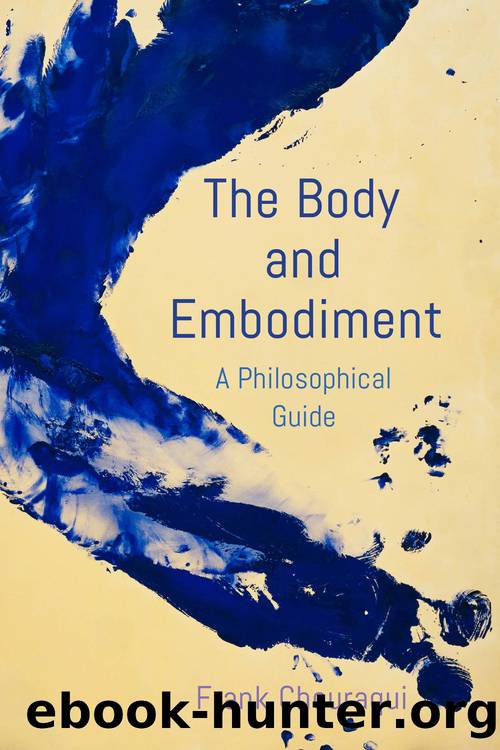
Author:Chouraqui, Frank
Language: eng
Format: epub
Publisher: Rowman & Littlefield Pub Inc
Published: 2021-04-08T00:00:00+00:00
Conclusion
I promised to deliver an account of an embodied world. Since the introduction of Merleau-Pontyâs ideas in the previous chapter, it was clear how the world and the body were dependent on each other, suggesting indeed that there was a sense in which the world was affected by embodiment. We can now propose a stronger sense in which the world can be said to be embodied: the world is generated and informed by the intentional activity of the body. How does it affect the way we must think of it? The foregoing suggests first, that the world, as a collection of objects, is falsely determined. Rather we should think of each object as dynamic in the sense that it can always be further determined, and indeed, experience is this endless process of determination. Second, the world is a historical movement of determination that, although endless, tends towards determination, and therefore towards objectification (this will have consequences for the political chapters). Third, the world, both at the individual and cultural level, relies on forgetfulness (the forgetfulness of indeterminacy, the forgetfulness that the world is merely an interpretation), and coincidentally, with belief. This suggests that belief is not justified by experience, but rather constitutive of it (Merleau-Ponty will later talk of a âperceptual faithâ). Finally, the world, as an illusion arising from constitution is best conceived as a collection of facts (units of meaning, in context) rather than objects.
Retroactively, this description of the world reflects onto one of its most particular members, the body.
1. In this context, the body becomes understood as the constitutive source of the world (as a substitute for and upgrade upon the transcendental ego) and therefore no longer as a constituted object (Körper) but as a constitutive force, whose structure itself leads into an illusion about itself: it is the nature of the intentional body to (falsely) regard itself as Körper. Earlier, we noted that Merleau-Ponty concludes from the stalemate of modern philosophy that as long as you begin with the mind or the body you will have the problem of interaction. Beginning in the middle, although itâs very difficult, is the only way you can account for interaction, and you must account for interaction because interaction is experience, and no one can deny that there is experience. You can have all sorts of debates about what is doing the experiencing, and what the experiencing is of. Is it experience of dreams? Is it the experience of truth? Is it the experience of reality? Is it the experience of the world? Is it the experience of yourself? What is undeniable is that there are experiences. We also just noted that this means beginning with Leib as an intermediary category that stands between two things-in-themselves: the ego and Körper. When we say Leib is the middle ground between Körper and ego, we also mean Leib is there before Körper and ego, which are results of a process of constitution which âendsâ in illusions called âobjectsâ (one of them is Körper, another ego).
Download
This site does not store any files on its server. We only index and link to content provided by other sites. Please contact the content providers to delete copyright contents if any and email us, we'll remove relevant links or contents immediately.
| Anthropology | Archaeology |
| Philosophy | Politics & Government |
| Social Sciences | Sociology |
| Women's Studies |
Cecilia; Or, Memoirs of an Heiress — Volume 1 by Fanny Burney(32558)
The Great Music City by Andrea Baker(32018)
Cecilia; Or, Memoirs of an Heiress — Volume 2 by Fanny Burney(31956)
Cecilia; Or, Memoirs of an Heiress — Volume 3 by Fanny Burney(31941)
We're Going to Need More Wine by Gabrielle Union(19046)
All the Missing Girls by Megan Miranda(16026)
Pimp by Iceberg Slim(14506)
For the Love of Europe by Rick Steves(14121)
Bombshells: Glamour Girls of a Lifetime by Sullivan Steve(14075)
Talking to Strangers by Malcolm Gladwell(13370)
Norse Mythology by Gaiman Neil(13363)
Fifty Shades Freed by E L James(13240)
Mindhunter: Inside the FBI's Elite Serial Crime Unit by John E. Douglas & Mark Olshaker(9342)
Crazy Rich Asians by Kevin Kwan(9292)
The Lost Art of Listening by Michael P. Nichols(7506)
Enlightenment Now: The Case for Reason, Science, Humanism, and Progress by Steven Pinker(7313)
The Four Agreements by Don Miguel Ruiz(6765)
Bad Blood by John Carreyrou(6621)
Weapons of Math Destruction by Cathy O'Neil(6279)
